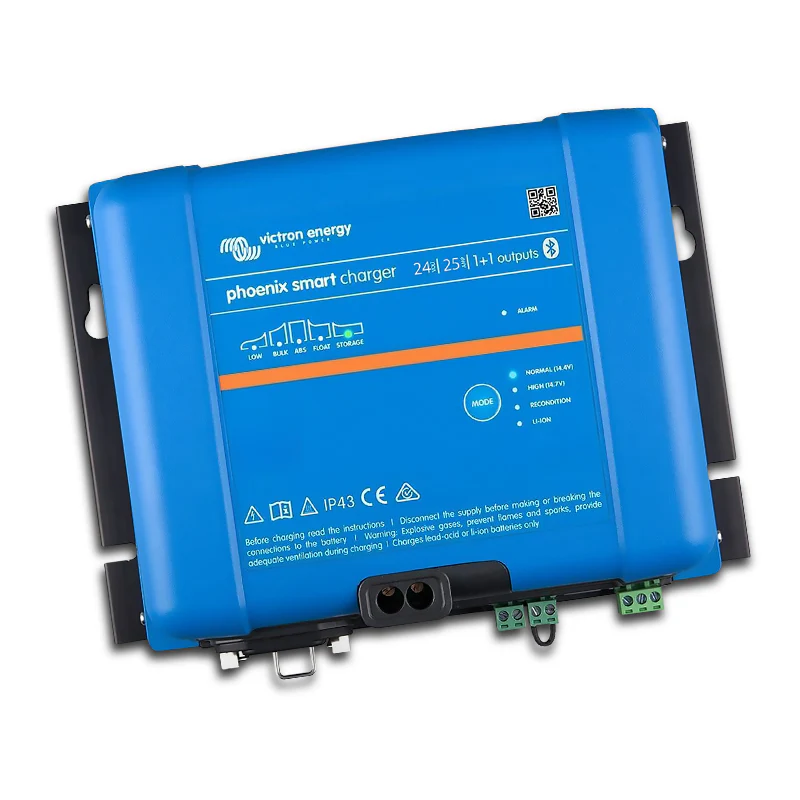
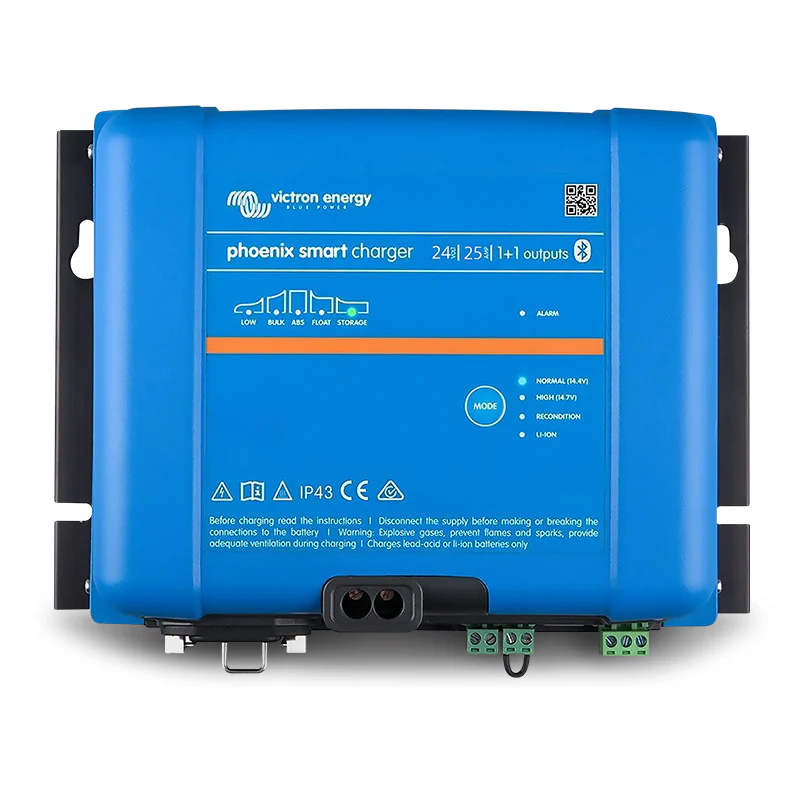
Victron Energy PSC242551095 Phoenix Smart IP43 Charger 24/25(1+1) 120-240V
Victron Energy Phoenix Smart IP43 24/25(1+1) Full Power to the House Bank. Starter Battery Topped Up. One Charger.
Product Overview
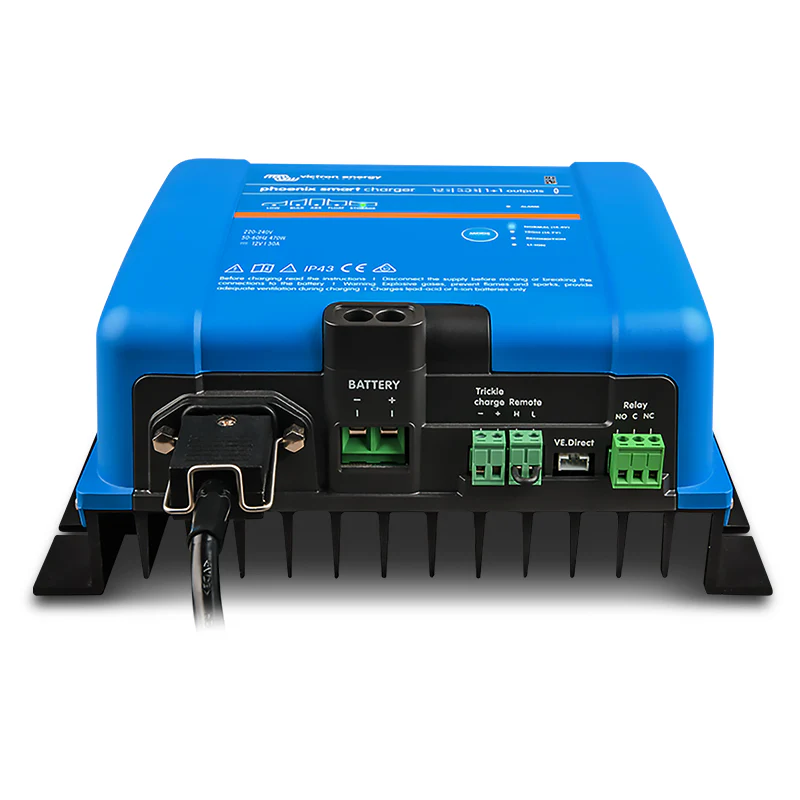
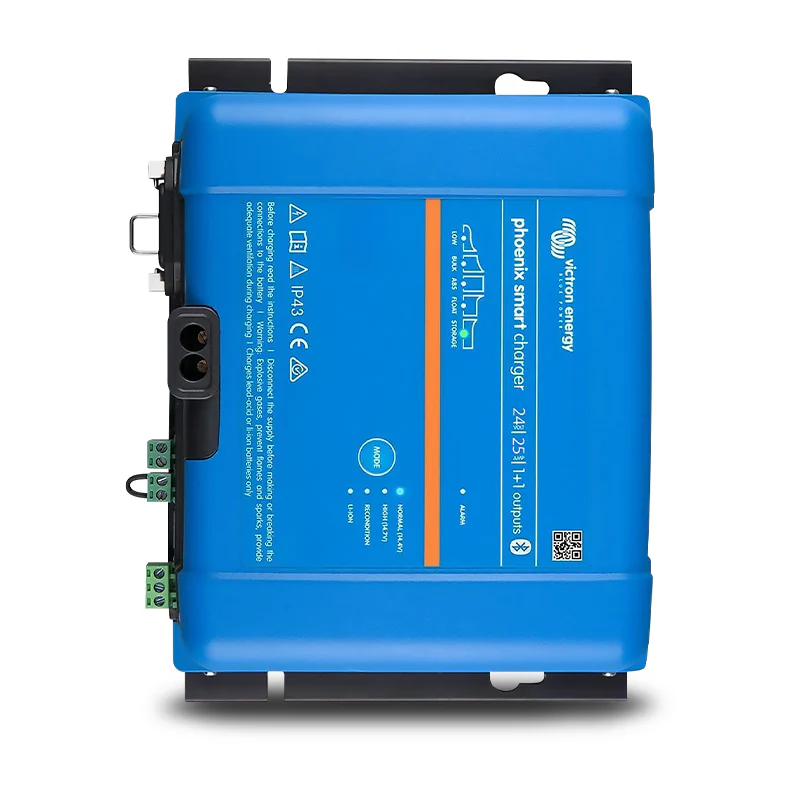
The Victron Energy Phoenix Smart IP43 24/25(1+1) (PSC242551095) is a professional-grade, Bluetooth-enabled dual-output 24V battery charger delivering up to 25 amps to a primary battery bank, while simultaneously maintaining a separate starter battery via a dedicated secondary output limited to approximately 3A at a slightly lower voltage. The (1+1) configuration is the correct choice for the most common marine and vehicle dual-battery scenario a large house or service bank that needs full-current managed charging, alongside a starter battery that simply needs to stay topped up during shore power connection.
Unlike the three-output (3) variant where all outputs can supply full rated current, the (1+1) is specifically engineered around the asymmetric needs of a start/house battery system. The house bank gets full 25A adaptive charging through five managed stages Bulk, Absorption, Recondition, Float, and Storage while the starter battery receives the small, steady current it needs to stay ready without the risk of overcharge from excessive current application. The BatterySafe mode adds an additional protection layer, automatically limiting the rate of voltage rise during high-current, high-voltage charge combinations to prevent battery damage from excessive gassing.
Bluetooth connectivity via VictronConnect enables full monitoring, configuration, and firmware updates from a smartphone. A VE.Direct port provides wired connectivity to a Cerbo GX or other Victron system devices, and the programmable relay allows integration with external equipment. The IP43 rating makes it suitable for marine engine rooms and enclosed battery compartments, and the 120–240V AC input handles both Australian and international shore power supplies.
Key Specifications
- Part Number: PSC242551095
- Charger Type: Adaptive dual-output AC-DC battery charger
- Output Voltage: 24V
- Output Configuration: (1+1) — one full-current primary output + one ~3A secondary output
- Primary Output: Up to 25A (full rated current — house/service bank)
- Secondary Output: Approximately 3A at slightly reduced voltage (starter battery)
- Input Voltage: 120–240V AC
- Charge Algorithm: Adaptive 5-stage — Bulk, Absorption, Recondition, Float, Storage
- BatterySafe Mode: Yes — limits voltage rise rate to prevent gassing damage
- Battery Compatibility: Lead acid (all types), LiFePO₄ lithium
- Pre-Programmed Algorithms: 3 (selectable via mode button)
- Fully Programmable: Yes — via Bluetooth or VE.Direct
- Bluetooth: Built-in (VictronConnect app — iOS and Android)
- VE.Direct Interface: Yes — wired connection to Cerbo GX, PC, or other devices
- Remote On/Off: Yes — switch, relay, or open-collector optocoupler
- Programmable Relay: Yes — configurable via VE.Direct or Bluetooth (AC power required)
- Automatic Voltage Compensation: Yes
- Storage Mode: Yes — activates after 24 hours without discharge; weekly equalisation
- IP Rating: IP43
- Input Frequency: Not specified — confirm with supplier
- Dimensions: Not specified — confirm with supplier
- Weight: 4.0 kg
- Efficiency: Not specified — confirm with supplier
Features & Benefits
- (1+1) Dual-Output — Full Charge to the House Bank, Maintenance to the Starter — The primary output delivers the full 25A rated current to the house or service battery bank through a complete 5-stage adaptive charge cycle. The secondary output provides approximately 3A at a slightly lower voltage — enough to keep a starter battery fully topped up without overcharging it or consuming primary bank current. This asymmetric design matches the real-world asymmetric needs of most marine and vehicle dual-battery systems.
- Adaptive 5-Stage Charge Algorithm — Five stages covering the complete charge and maintenance cycle of the primary battery bank. Bulk delivers maximum current for rapid recharge. Absorption holds at the correct voltage while current tapers. Recondition recovers sulphated lead acid batteries that have deteriorated from repeated partial charging. Float safely maintains a full battery. Storage Mode activates after 24 hours without discharge, reducing float voltage to 2.2V/cell to minimise electrolyte gassing and positive plate corrosion, with a weekly equalisation pulse to prevent stratification and sulphation during extended layup.
- BatterySafe Mode — When a high charge current is combined with a high absorption voltage — a common setup for rapid charging — excessive gassing can occur once the battery reaches its gassing voltage threshold. BatterySafe automatically limits the rate of voltage increase after the gassing voltage is reached, protecting the battery from damage without reducing overall charge effectiveness. A meaningful safety feature for installations using high charge currents or elevated absorption setpoints.
- Variable Absorption Time — Discharge-Depth Adaptive — Shallow discharges trigger short absorption to prevent overcharge on a battery that doesn't need extended topping up. Deep discharges trigger extended absorption to ensure the battery returns to 100% state of charge. The charger determines this automatically from voltage behaviour during the bulk stage — no manual adjustment required.
- Storage Mode — Protects During Layup — Activates automatically after 24 hours without a discharge event. Float voltage reduces to 2.2V/cell to minimise electrolyte gassing and positive plate corrosion. A weekly absorption-voltage pulse prevents stratification of the electrolyte and sulphation of the plates — the two primary causes of premature lead acid battery failure during extended shore power or storage periods.
- LiFePO₄ Lithium Battery Support — LiFePO₄ battery profiles are configurable via Bluetooth or VE.Direct, with a 3-stage algorithm selected for lithium operation. BMS charge/discharge control is implemented via the remote on/off port — connecting a BMS relay or open-collector optocoupler output to the H/L terminals allows the BMS to halt charging as required. Full voltage and current control is also achievable via Bluetooth.
- Automatic Voltage Compensation — Increases output voltage slightly in proportion to DC output current to compensate for resistive voltage drop over long cable runs between charger and battery. Ensures the battery receives the correct charge voltage regardless of cable length — important in marine and motorhome installations where battery banks are located away from the charger.
- Built-In Bluetooth — VictronConnect App — Monitor real-time charge status, configure battery profiles, set alarms, and update firmware from any iOS or Android device. Direct Bluetooth access without additional hardware.
- VE.Direct Interface — Cerbo GX and System Integration — Wired VE.Direct connection allows integration with a Victron Cerbo GX for full system monitoring and control via the VRM portal or GX touch display. Also supports wired connection to a PC for configuration and data logging.
- Programmable Relay — The onboard relay is user-configurable to activate on a defined event — alarm condition, charge complete, temperature threshold, or other trigger — via VE.Direct or Bluetooth. Note: the relay is only active while the charger is connected to AC power.
- Remote On/Off — External charger control via a remote switch, relay contact, or open-collector optocoupler. Supports BMS charge control, panel-mounted switches, and automation system integration.
- Wide 120–240V AC Input — Accepts both Australian 240V and North American 120V shore power without manual voltage selection. Suitable for vessels and vehicles operating across international destinations.
- IP43 Rated — Protected against solid objects greater than 1mm and water spray up to 60° from vertical. Suitable for marine engine rooms and protected enclosed battery compartments with incidental moisture exposure.
Technical Specs
| Specification | Detail |
|---|---|
| Part Number | PSC242551095 |
| Charger Type | Adaptive dual-output AC-DC battery charger |
| Output Voltage | 24V |
| Output Configuration | (1+1) |
| Primary Output | Up to 25A (house/service bank) |
| Secondary Output | ~3A at slightly reduced voltage (starter battery) |
| Input Voltage | 120–240V AC |
| Charge Algorithm | Adaptive 5-stage: Bulk, Absorption, Recondition, Float, Storage |
| BatterySafe Mode | Yes |
| Battery Compatibility | Lead acid (all types) + LiFePO₄ lithium |
| Lithium Algorithm | 3-stage (configurable via Bluetooth or VE.Direct) |
| Pre-Programmed Profiles | 3 (mode button selectable) |
| Fully Programmable | Yes — Bluetooth or VE.Direct |
| Bluetooth | Built-in (VictronConnect — iOS and Android) |
| VE.Direct Interface | Yes |
| Remote On/Off | Yes — switch, relay, or open-collector optocoupler |
| Programmable Relay | Yes — active during AC connection only |
| Automatic Voltage Compensation | Yes |
| Storage Mode | Yes — activates after 24hr; weekly equalisation pulse |
| IP Rating | IP43 |
| Input Frequency | Not specified — confirm with supplier |
| Efficiency | Not specified — confirm with supplier |
| Dimensions | Not specified — confirm with supplier |
| Weight | 4.0 kg |
Compatible With / Goes Well With
Primary Applications:
- Marine vessels with 24V house bank and separate 24V starter battery
- Motorhomes and campervans with 24V house bank and chassis starter battery
- Off-grid and touring vehicles with 24V primary service bank and dedicated start bank
- Any 24V dual-battery installation requiring full managed charging on the primary bank and maintenance charging on the secondary
Battery Types:
- All lead acid chemistries — flooded, AGM, gel (24V primary and secondary)
- LiFePO₄ lithium (24V primary bank) — BMS integration via remote on/off
System Integration:
- Victron Cerbo GX (via VE.Direct — for system monitoring and VRM portal)
- Victron SmartShunt or BMV-712 (battery bank monitoring)
- Victron VictronConnect app (free — iOS and Android)
Weight
4.0 kg
Frequently Asked Questions
What is the difference between the (1+1) and (3) configurations of the Phoenix Smart IP43?
The (1+1) — this model — provides a full-current primary output (up to 25A) for the house bank and a secondary output limited to approximately 3A for a starter battery. The (3) provides three outputs each capable of the full rated current, with the combined total capped at 25A — designed for three similarly sized banks. Choose (1+1) when one large bank needs full charging and a starter battery needs maintenance. Choose (3) when three independent banks each need significant current.
What does BatterySafe mode do and when does it activate?
BatterySafe activates when a high charge current is combined with a high absorption voltage setting, and the battery approaches its gassing voltage threshold. Rather than allowing the voltage to continue rising rapidly — which causes excessive gassing that can damage plates and reduce electrolyte — BatterySafe limits the rate of voltage increase, protecting the battery without interrupting the charge cycle.
Can I monitor and configure this charger without being physically next to it?
Via Bluetooth, you can monitor and configure the charger from any nearby Bluetooth-enabled iOS or Android device. For remote monitoring over the internet, a Cerbo GX connected via VE.Direct integrates the charger into the Victron VRM portal — enabling monitoring and some control functions from anywhere with an internet connection.
Can this charger be controlled by a lithium BMS?
Yes. Connect the BMS relay or open-collector optocoupler output to the remote on/off H/L terminals. When the BMS signals that charging should stop — due to full state of charge, over-temperature, or a protection event — it opens the remote on/off circuit, disabling the charger until charging is permitted again. Full charge voltage and current control is also achievable via Bluetooth for more advanced BMS integration.
What is Storage Mode and how does it protect my batteries during layup?
Storage Mode activates automatically when the battery has not been discharged for 24 hours — typical when a vessel or vehicle is connected to shore power but not in use. Float voltage drops to 2.2V/cell to minimise electrolyte gassing and positive plate corrosion. Once per week the voltage rises to absorption level to equalise the battery, preventing electrolyte stratification and sulphation — the two leading causes of premature lead acid battery failure during extended storage.
Product Information
Product Information
Shipping & Returns
Shipping & Returns
Description
Victron Energy Phoenix Smart IP43 24/25(1+1) Full Power to the House Bank. Starter Battery Topped Up. One Charger.
Product Overview
The Victron Energy Phoenix Smart IP43 24/25(1+1) (PSC242551095) is a professional-grade, Bluetooth-enabled dual-output 24V battery charger delivering up to 25 amps to a primary battery bank, while simultaneously maintaining a separate starter battery via a dedicated secondary output limited to approximately 3A at a slightly lower voltage. The (1+1) configuration is the correct choice for the most common marine and vehicle dual-battery scenario a large house or service bank that needs full-current managed charging, alongside a starter battery that simply needs to stay topped up during shore power connection.
Unlike the three-output (3) variant where all outputs can supply full rated current, the (1+1) is specifically engineered around the asymmetric needs of a start/house battery system. The house bank gets full 25A adaptive charging through five managed stages Bulk, Absorption, Recondition, Float, and Storage while the starter battery receives the small, steady current it needs to stay ready without the risk of overcharge from excessive current application. The BatterySafe mode adds an additional protection layer, automatically limiting the rate of voltage rise during high-current, high-voltage charge combinations to prevent battery damage from excessive gassing.
Bluetooth connectivity via VictronConnect enables full monitoring, configuration, and firmware updates from a smartphone. A VE.Direct port provides wired connectivity to a Cerbo GX or other Victron system devices, and the programmable relay allows integration with external equipment. The IP43 rating makes it suitable for marine engine rooms and enclosed battery compartments, and the 120–240V AC input handles both Australian and international shore power supplies.
Key Specifications
- Part Number: PSC242551095
- Charger Type: Adaptive dual-output AC-DC battery charger
- Output Voltage: 24V
- Output Configuration: (1+1) — one full-current primary output + one ~3A secondary output
- Primary Output: Up to 25A (full rated current — house/service bank)
- Secondary Output: Approximately 3A at slightly reduced voltage (starter battery)
- Input Voltage: 120–240V AC
- Charge Algorithm: Adaptive 5-stage — Bulk, Absorption, Recondition, Float, Storage
- BatterySafe Mode: Yes — limits voltage rise rate to prevent gassing damage
- Battery Compatibility: Lead acid (all types), LiFePO₄ lithium
- Pre-Programmed Algorithms: 3 (selectable via mode button)
- Fully Programmable: Yes — via Bluetooth or VE.Direct
- Bluetooth: Built-in (VictronConnect app — iOS and Android)
- VE.Direct Interface: Yes — wired connection to Cerbo GX, PC, or other devices
- Remote On/Off: Yes — switch, relay, or open-collector optocoupler
- Programmable Relay: Yes — configurable via VE.Direct or Bluetooth (AC power required)
- Automatic Voltage Compensation: Yes
- Storage Mode: Yes — activates after 24 hours without discharge; weekly equalisation
- IP Rating: IP43
- Input Frequency: Not specified — confirm with supplier
- Dimensions: Not specified — confirm with supplier
- Weight: 4.0 kg
- Efficiency: Not specified — confirm with supplier
Features & Benefits
- (1+1) Dual-Output — Full Charge to the House Bank, Maintenance to the Starter — The primary output delivers the full 25A rated current to the house or service battery bank through a complete 5-stage adaptive charge cycle. The secondary output provides approximately 3A at a slightly lower voltage — enough to keep a starter battery fully topped up without overcharging it or consuming primary bank current. This asymmetric design matches the real-world asymmetric needs of most marine and vehicle dual-battery systems.
- Adaptive 5-Stage Charge Algorithm — Five stages covering the complete charge and maintenance cycle of the primary battery bank. Bulk delivers maximum current for rapid recharge. Absorption holds at the correct voltage while current tapers. Recondition recovers sulphated lead acid batteries that have deteriorated from repeated partial charging. Float safely maintains a full battery. Storage Mode activates after 24 hours without discharge, reducing float voltage to 2.2V/cell to minimise electrolyte gassing and positive plate corrosion, with a weekly equalisation pulse to prevent stratification and sulphation during extended layup.
- BatterySafe Mode — When a high charge current is combined with a high absorption voltage — a common setup for rapid charging — excessive gassing can occur once the battery reaches its gassing voltage threshold. BatterySafe automatically limits the rate of voltage increase after the gassing voltage is reached, protecting the battery from damage without reducing overall charge effectiveness. A meaningful safety feature for installations using high charge currents or elevated absorption setpoints.
- Variable Absorption Time — Discharge-Depth Adaptive — Shallow discharges trigger short absorption to prevent overcharge on a battery that doesn't need extended topping up. Deep discharges trigger extended absorption to ensure the battery returns to 100% state of charge. The charger determines this automatically from voltage behaviour during the bulk stage — no manual adjustment required.
- Storage Mode — Protects During Layup — Activates automatically after 24 hours without a discharge event. Float voltage reduces to 2.2V/cell to minimise electrolyte gassing and positive plate corrosion. A weekly absorption-voltage pulse prevents stratification of the electrolyte and sulphation of the plates — the two primary causes of premature lead acid battery failure during extended shore power or storage periods.
- LiFePO₄ Lithium Battery Support — LiFePO₄ battery profiles are configurable via Bluetooth or VE.Direct, with a 3-stage algorithm selected for lithium operation. BMS charge/discharge control is implemented via the remote on/off port — connecting a BMS relay or open-collector optocoupler output to the H/L terminals allows the BMS to halt charging as required. Full voltage and current control is also achievable via Bluetooth.
- Automatic Voltage Compensation — Increases output voltage slightly in proportion to DC output current to compensate for resistive voltage drop over long cable runs between charger and battery. Ensures the battery receives the correct charge voltage regardless of cable length — important in marine and motorhome installations where battery banks are located away from the charger.
- Built-In Bluetooth — VictronConnect App — Monitor real-time charge status, configure battery profiles, set alarms, and update firmware from any iOS or Android device. Direct Bluetooth access without additional hardware.
- VE.Direct Interface — Cerbo GX and System Integration — Wired VE.Direct connection allows integration with a Victron Cerbo GX for full system monitoring and control via the VRM portal or GX touch display. Also supports wired connection to a PC for configuration and data logging.
- Programmable Relay — The onboard relay is user-configurable to activate on a defined event — alarm condition, charge complete, temperature threshold, or other trigger — via VE.Direct or Bluetooth. Note: the relay is only active while the charger is connected to AC power.
- Remote On/Off — External charger control via a remote switch, relay contact, or open-collector optocoupler. Supports BMS charge control, panel-mounted switches, and automation system integration.
- Wide 120–240V AC Input — Accepts both Australian 240V and North American 120V shore power without manual voltage selection. Suitable for vessels and vehicles operating across international destinations.
- IP43 Rated — Protected against solid objects greater than 1mm and water spray up to 60° from vertical. Suitable for marine engine rooms and protected enclosed battery compartments with incidental moisture exposure.
Technical Specs
| Specification | Detail |
|---|---|
| Part Number | PSC242551095 |
| Charger Type | Adaptive dual-output AC-DC battery charger |
| Output Voltage | 24V |
| Output Configuration | (1+1) |
| Primary Output | Up to 25A (house/service bank) |
| Secondary Output | ~3A at slightly reduced voltage (starter battery) |
| Input Voltage | 120–240V AC |
| Charge Algorithm | Adaptive 5-stage: Bulk, Absorption, Recondition, Float, Storage |
| BatterySafe Mode | Yes |
| Battery Compatibility | Lead acid (all types) + LiFePO₄ lithium |
| Lithium Algorithm | 3-stage (configurable via Bluetooth or VE.Direct) |
| Pre-Programmed Profiles | 3 (mode button selectable) |
| Fully Programmable | Yes — Bluetooth or VE.Direct |
| Bluetooth | Built-in (VictronConnect — iOS and Android) |
| VE.Direct Interface | Yes |
| Remote On/Off | Yes — switch, relay, or open-collector optocoupler |
| Programmable Relay | Yes — active during AC connection only |
| Automatic Voltage Compensation | Yes |
| Storage Mode | Yes — activates after 24hr; weekly equalisation pulse |
| IP Rating | IP43 |
| Input Frequency | Not specified — confirm with supplier |
| Efficiency | Not specified — confirm with supplier |
| Dimensions | Not specified — confirm with supplier |
| Weight | 4.0 kg |
Compatible With / Goes Well With
Primary Applications:
- Marine vessels with 24V house bank and separate 24V starter battery
- Motorhomes and campervans with 24V house bank and chassis starter battery
- Off-grid and touring vehicles with 24V primary service bank and dedicated start bank
- Any 24V dual-battery installation requiring full managed charging on the primary bank and maintenance charging on the secondary
Battery Types:
- All lead acid chemistries — flooded, AGM, gel (24V primary and secondary)
- LiFePO₄ lithium (24V primary bank) — BMS integration via remote on/off
System Integration:
- Victron Cerbo GX (via VE.Direct — for system monitoring and VRM portal)
- Victron SmartShunt or BMV-712 (battery bank monitoring)
- Victron VictronConnect app (free — iOS and Android)
Weight
4.0 kg
Frequently Asked Questions
What is the difference between the (1+1) and (3) configurations of the Phoenix Smart IP43?
The (1+1) — this model — provides a full-current primary output (up to 25A) for the house bank and a secondary output limited to approximately 3A for a starter battery. The (3) provides three outputs each capable of the full rated current, with the combined total capped at 25A — designed for three similarly sized banks. Choose (1+1) when one large bank needs full charging and a starter battery needs maintenance. Choose (3) when three independent banks each need significant current.
What does BatterySafe mode do and when does it activate?
BatterySafe activates when a high charge current is combined with a high absorption voltage setting, and the battery approaches its gassing voltage threshold. Rather than allowing the voltage to continue rising rapidly — which causes excessive gassing that can damage plates and reduce electrolyte — BatterySafe limits the rate of voltage increase, protecting the battery without interrupting the charge cycle.
Can I monitor and configure this charger without being physically next to it?
Via Bluetooth, you can monitor and configure the charger from any nearby Bluetooth-enabled iOS or Android device. For remote monitoring over the internet, a Cerbo GX connected via VE.Direct integrates the charger into the Victron VRM portal — enabling monitoring and some control functions from anywhere with an internet connection.
Can this charger be controlled by a lithium BMS?
Yes. Connect the BMS relay or open-collector optocoupler output to the remote on/off H/L terminals. When the BMS signals that charging should stop — due to full state of charge, over-temperature, or a protection event — it opens the remote on/off circuit, disabling the charger until charging is permitted again. Full charge voltage and current control is also achievable via Bluetooth for more advanced BMS integration.
What is Storage Mode and how does it protect my batteries during layup?
Storage Mode activates automatically when the battery has not been discharged for 24 hours — typical when a vessel or vehicle is connected to shore power but not in use. Float voltage drops to 2.2V/cell to minimise electrolyte gassing and positive plate corrosion. Once per week the voltage rises to absorption level to equalise the battery, preventing electrolyte stratification and sulphation — the two leading causes of premature lead acid battery failure during extended storage.