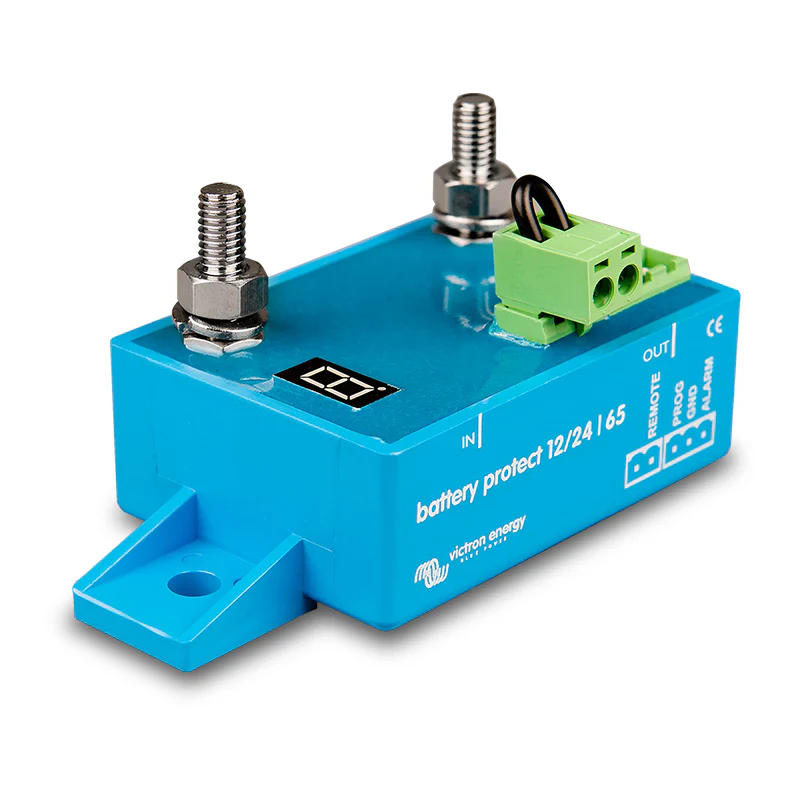
Victron Energy BPR000065400 Battery Protect 12/24V-65A
Protect Your Battery from Deep Discharge 12/24V Auto-Ranging, 65A MOSFET, Li-Ion Mode, Over-Voltage Protection.
Product Overview
The Victron Energy Battery Protect 12/24V-65A (BPR000065400) is an intelligent load disconnect device that protects 12V and 24V batteries from over-discharge damage by automatically disconnecting non-essential loads before the battery reaches a critically low voltage. Whether protecting a starter battery's engine-cranking reserve or preventing a deep-cycle auxiliary battery from entering damaging over-discharge, the Battery Protect operates silently and automatically without relays, without sparks, and without requiring manual intervention.
Using MOSFET solid-state switching rather than traditional relays, the unit is ignition-proof and generates no sparks on connect or disconnect an important safety consideration in enclosed battery compartments and fuel-adjacent installations. A dedicated Li-ion battery mode allows direct control by the Victron VE.Bus BMS, and the Battery Protect can also be used as a charge interrupter between a charger and a Li-ion battery. Over-voltage protection disconnects the load whenever DC voltage exceeds 16V (12V systems) or 32V (24V systems), protecting sensitive downstream equipment from voltage spikes and charger faults.
Key Specifications
- Voltage: 12V / 24V (auto-ranging — automatic system voltage detection)
- Maximum continuous current: 65A
- Switching technology: MOSFET (solid-state — no relays, no sparks)
- Li-ion battery mode: Yes — controllable by Victron VE.Bus BMS
- Charge interrupter function: Yes (between charger and Li-ion battery)
- Over-voltage protection: Disconnects at >16V (12V system) or >32V (24V system)
- Alarm output: Delayed alarm — activates after battery voltage drops below preset level for more than 12 seconds
- Alarm output type: Short circuit-proof open collector, max 50mA, negative rail
- Alarm output use: Buzzer, LED, or relay activation
- Load disconnect delay: 90 seconds after alarm activation
- Load reconnect delay: 30 seconds after voltage recovers above reconnect threshold
- Disconnect voltage: Programmable — selectable via 7-segment display
- Reconnect voltage: Programmable — selectable via 7-segment display
- Current consumption: Ultra-low (exact figure not specified — confirm with Victron)
- Dimensions: Not specified — confirm with Victron
- Weight: Not specified — confirm with Victron
- Warranty: Not specified — confirm with Victron
- IP rating: Not specified — confirm with Victron
Features & Benefits
- Automatic Over-Discharge Protection — The Battery Protect monitors battery voltage continuously and disconnects non-essential loads before the battery drops to a damaging level — preserving capacity for engine cranking, extending battery cycle life, and preventing the permanent capacity loss that occurs when lead-acid and lithium batteries are repeatedly over-discharged.
- 12/24V Auto-Ranging — Automatically detects whether the system is 12V or 24V and configures accordingly — a single SKU that covers both system voltages without jumpers, switches, or manual configuration.
- MOSFET Solid-State Switching — Ignition Proof — Unlike relay-based disconnects, MOSFET switching produces no sparks on connect or disconnect — meeting ignition-proof requirements for installations in enclosed compartments, boats with fuel vapour risk, and any location where a relay arc could be hazardous.
- Programmable Disconnect and Reconnect Voltages — The 7-segment display allows the user to select from multiple preset disconnect and reconnect thresholds — matching the Battery Protect's behaviour to the specific battery chemistry (flooded, AGM, Gel, or Li-ion) and system requirements without requiring additional tools or software.
- Li-Ion Battery Mode with VE.Bus BMS Integration — In Li-ion mode, the Battery Protect can be directly controlled by the Victron VE.Bus BMS — enabling coordinated battery management where the BMS governs the protect function alongside cell balancing and protection. Can also function as a charge interrupter between a charger and Li-ion battery.
- Over-Voltage Protection — Automatically disconnects the load if voltage exceeds 16V on a 12V system or 32V on a 24V system — protecting sensitive electronics, inverters, and accessories downstream from charger faults or voltage spikes.
- Delayed Alarm with 12-Second Hold-Off — The alarm output activates only after the battery voltage has remained below the preset disconnect level for more than 12 seconds — preventing false alarms triggered by the momentary voltage dip during engine cranking. The alarm output (open collector, max 50mA) can drive a buzzer, LED, or relay.
- Intelligent Disconnect and Reconnect Timing — Loads are not disconnected immediately when the alarm triggers. A 90-second delay allows the vehicle operator time to start the engine and allow voltage to recover. If voltage recovers within this window, the load is never disconnected. Once reconnected, a 30-second delay prevents rapid cycling if voltage fluctuates near the reconnect threshold.
- Ultra-Low Current Consumption — The Battery Protect's own standby current draw is ultra-low — particularly important in Li-ion battery systems where even small parasitic loads can trigger a low-voltage shutdown after extended storage. Exact standby current not specified — confirm with Victron.
Technical Specs
| Specification | Detail |
|---|---|
| Brand | Victron Energy |
| Part Number | BPR000065400 |
| Voltage | 12V / 24V (auto-ranging) |
| Maximum Continuous Current | 65A |
| Switching Technology | MOSFET (ignition-proof, no sparks) |
| Li-Ion Mode | Yes — VE.Bus BMS controllable |
| Charge Interrupter Function | Yes |
| Over-Voltage Disconnect (12V) | >16V |
| Over-Voltage Disconnect (24V) | >32V |
| Alarm Activation Delay | 12 seconds below preset threshold |
| Alarm Output | Open collector, max 50mA, negative rail |
| Load Disconnect Delay | 90 seconds after alarm |
| Load Reconnect Delay | 30 seconds after voltage recovery |
| Disconnect Voltage | Programmable (7-segment display) |
| Reconnect Voltage | Programmable (7-segment display) |
| Standby Current | Ultra-low (exact figure not specified) |
| IP Rating | Not specified |
| Dimensions | Not specified |
| Weight | Not specified |
| Warranty | Not specified — confirm with Victron |
Compatible With / Goes Well With
Suitable applications:
- Dual battery systems — protecting auxiliary battery from over-discharge
- Marine battery installations — load disconnect with ignition-proof switching
- Caravan and RV auxiliary battery protection
- Off-grid solar power systems — battery low-voltage load shedding
- Li-ion battery installations with Victron VE.Bus BMS integration
- Protecting sensitive electronics from over-voltage events
Compatible Victron accessories:
- Victron Energy VE.Bus BMS (for Li-ion battery mode control)
- Victron Energy Blue Smart IP65 and IP67 battery chargers
- Victron Energy SmartSolar MPPT charge controllers
- Victron Energy BMV battery monitors — for paired voltage monitoring alongside the Battery Protect
- Victron Energy Cerbo GX and GX device platform
Frequently Asked Questions
What does the Victron Battery Protect actually do?
The Battery Protect monitors battery voltage and automatically disconnects non-essential loads before the battery drops to a level that would cause permanent damage. Once voltage recovers — after charging or engine start — it reconnects loads automatically with a 30-second delay. It protects battery health and preserves cranking reserve without requiring manual intervention.
Why does the Battery Protect use MOSFETs instead of relays?
MOSFET switching is ignition-proof — it produces no electrical spark on connect or disconnect, unlike relay-based disconnects. This is an important safety requirement for enclosed battery compartments and marine installations where fuel vapour or hydrogen gas from charging lead-acid batteries may be present.
Can the Battery Protect be used with Lithium (Li-ion/LiFePO4) batteries?
Yes. The Battery Protect includes a dedicated Li-ion mode that allows direct control by the Victron VE.Bus BMS. It can also be configured as a charge interrupter between a charger and a Li-ion battery. Refer to the Victron Battery Protect manual and VE.Bus BMS documentation for correct wiring and configuration.
What is the purpose of the 12-second alarm delay before load disconnect?
The 12-second delay prevents the alarm from triggering during momentary voltage dips caused by engine cranking — where battery voltage can drop significantly for a few seconds before recovering. Without this delay, the alarm (and subsequent load disconnect) would be triggered every time the engine was started.
What happens during the 90-second load disconnect delay?
When the alarm triggers, loads remain connected for 90 seconds. If the battery voltage recovers to the reconnect threshold within this 90-second window — for example, because the engine has been started — loads are never disconnected. This prevents unnecessary interruption to non-essential systems during normal vehicle operation.
Product Information
Product Information
Shipping & Returns
Shipping & Returns
Description
Protect Your Battery from Deep Discharge 12/24V Auto-Ranging, 65A MOSFET, Li-Ion Mode, Over-Voltage Protection.
Product Overview
The Victron Energy Battery Protect 12/24V-65A (BPR000065400) is an intelligent load disconnect device that protects 12V and 24V batteries from over-discharge damage by automatically disconnecting non-essential loads before the battery reaches a critically low voltage. Whether protecting a starter battery's engine-cranking reserve or preventing a deep-cycle auxiliary battery from entering damaging over-discharge, the Battery Protect operates silently and automatically without relays, without sparks, and without requiring manual intervention.
Using MOSFET solid-state switching rather than traditional relays, the unit is ignition-proof and generates no sparks on connect or disconnect an important safety consideration in enclosed battery compartments and fuel-adjacent installations. A dedicated Li-ion battery mode allows direct control by the Victron VE.Bus BMS, and the Battery Protect can also be used as a charge interrupter between a charger and a Li-ion battery. Over-voltage protection disconnects the load whenever DC voltage exceeds 16V (12V systems) or 32V (24V systems), protecting sensitive downstream equipment from voltage spikes and charger faults.
Key Specifications
- Voltage: 12V / 24V (auto-ranging — automatic system voltage detection)
- Maximum continuous current: 65A
- Switching technology: MOSFET (solid-state — no relays, no sparks)
- Li-ion battery mode: Yes — controllable by Victron VE.Bus BMS
- Charge interrupter function: Yes (between charger and Li-ion battery)
- Over-voltage protection: Disconnects at >16V (12V system) or >32V (24V system)
- Alarm output: Delayed alarm — activates after battery voltage drops below preset level for more than 12 seconds
- Alarm output type: Short circuit-proof open collector, max 50mA, negative rail
- Alarm output use: Buzzer, LED, or relay activation
- Load disconnect delay: 90 seconds after alarm activation
- Load reconnect delay: 30 seconds after voltage recovers above reconnect threshold
- Disconnect voltage: Programmable — selectable via 7-segment display
- Reconnect voltage: Programmable — selectable via 7-segment display
- Current consumption: Ultra-low (exact figure not specified — confirm with Victron)
- Dimensions: Not specified — confirm with Victron
- Weight: Not specified — confirm with Victron
- Warranty: Not specified — confirm with Victron
- IP rating: Not specified — confirm with Victron
Features & Benefits
- Automatic Over-Discharge Protection — The Battery Protect monitors battery voltage continuously and disconnects non-essential loads before the battery drops to a damaging level — preserving capacity for engine cranking, extending battery cycle life, and preventing the permanent capacity loss that occurs when lead-acid and lithium batteries are repeatedly over-discharged.
- 12/24V Auto-Ranging — Automatically detects whether the system is 12V or 24V and configures accordingly — a single SKU that covers both system voltages without jumpers, switches, or manual configuration.
- MOSFET Solid-State Switching — Ignition Proof — Unlike relay-based disconnects, MOSFET switching produces no sparks on connect or disconnect — meeting ignition-proof requirements for installations in enclosed compartments, boats with fuel vapour risk, and any location where a relay arc could be hazardous.
- Programmable Disconnect and Reconnect Voltages — The 7-segment display allows the user to select from multiple preset disconnect and reconnect thresholds — matching the Battery Protect's behaviour to the specific battery chemistry (flooded, AGM, Gel, or Li-ion) and system requirements without requiring additional tools or software.
- Li-Ion Battery Mode with VE.Bus BMS Integration — In Li-ion mode, the Battery Protect can be directly controlled by the Victron VE.Bus BMS — enabling coordinated battery management where the BMS governs the protect function alongside cell balancing and protection. Can also function as a charge interrupter between a charger and Li-ion battery.
- Over-Voltage Protection — Automatically disconnects the load if voltage exceeds 16V on a 12V system or 32V on a 24V system — protecting sensitive electronics, inverters, and accessories downstream from charger faults or voltage spikes.
- Delayed Alarm with 12-Second Hold-Off — The alarm output activates only after the battery voltage has remained below the preset disconnect level for more than 12 seconds — preventing false alarms triggered by the momentary voltage dip during engine cranking. The alarm output (open collector, max 50mA) can drive a buzzer, LED, or relay.
- Intelligent Disconnect and Reconnect Timing — Loads are not disconnected immediately when the alarm triggers. A 90-second delay allows the vehicle operator time to start the engine and allow voltage to recover. If voltage recovers within this window, the load is never disconnected. Once reconnected, a 30-second delay prevents rapid cycling if voltage fluctuates near the reconnect threshold.
- Ultra-Low Current Consumption — The Battery Protect's own standby current draw is ultra-low — particularly important in Li-ion battery systems where even small parasitic loads can trigger a low-voltage shutdown after extended storage. Exact standby current not specified — confirm with Victron.
Technical Specs
| Specification | Detail |
|---|---|
| Brand | Victron Energy |
| Part Number | BPR000065400 |
| Voltage | 12V / 24V (auto-ranging) |
| Maximum Continuous Current | 65A |
| Switching Technology | MOSFET (ignition-proof, no sparks) |
| Li-Ion Mode | Yes — VE.Bus BMS controllable |
| Charge Interrupter Function | Yes |
| Over-Voltage Disconnect (12V) | >16V |
| Over-Voltage Disconnect (24V) | >32V |
| Alarm Activation Delay | 12 seconds below preset threshold |
| Alarm Output | Open collector, max 50mA, negative rail |
| Load Disconnect Delay | 90 seconds after alarm |
| Load Reconnect Delay | 30 seconds after voltage recovery |
| Disconnect Voltage | Programmable (7-segment display) |
| Reconnect Voltage | Programmable (7-segment display) |
| Standby Current | Ultra-low (exact figure not specified) |
| IP Rating | Not specified |
| Dimensions | Not specified |
| Weight | Not specified |
| Warranty | Not specified — confirm with Victron |
Compatible With / Goes Well With
Suitable applications:
- Dual battery systems — protecting auxiliary battery from over-discharge
- Marine battery installations — load disconnect with ignition-proof switching
- Caravan and RV auxiliary battery protection
- Off-grid solar power systems — battery low-voltage load shedding
- Li-ion battery installations with Victron VE.Bus BMS integration
- Protecting sensitive electronics from over-voltage events
Compatible Victron accessories:
- Victron Energy VE.Bus BMS (for Li-ion battery mode control)
- Victron Energy Blue Smart IP65 and IP67 battery chargers
- Victron Energy SmartSolar MPPT charge controllers
- Victron Energy BMV battery monitors — for paired voltage monitoring alongside the Battery Protect
- Victron Energy Cerbo GX and GX device platform
Frequently Asked Questions
What does the Victron Battery Protect actually do?
The Battery Protect monitors battery voltage and automatically disconnects non-essential loads before the battery drops to a level that would cause permanent damage. Once voltage recovers — after charging or engine start — it reconnects loads automatically with a 30-second delay. It protects battery health and preserves cranking reserve without requiring manual intervention.
Why does the Battery Protect use MOSFETs instead of relays?
MOSFET switching is ignition-proof — it produces no electrical spark on connect or disconnect, unlike relay-based disconnects. This is an important safety requirement for enclosed battery compartments and marine installations where fuel vapour or hydrogen gas from charging lead-acid batteries may be present.
Can the Battery Protect be used with Lithium (Li-ion/LiFePO4) batteries?
Yes. The Battery Protect includes a dedicated Li-ion mode that allows direct control by the Victron VE.Bus BMS. It can also be configured as a charge interrupter between a charger and a Li-ion battery. Refer to the Victron Battery Protect manual and VE.Bus BMS documentation for correct wiring and configuration.
What is the purpose of the 12-second alarm delay before load disconnect?
The 12-second delay prevents the alarm from triggering during momentary voltage dips caused by engine cranking — where battery voltage can drop significantly for a few seconds before recovering. Without this delay, the alarm (and subsequent load disconnect) would be triggered every time the engine was started.
What happens during the 90-second load disconnect delay?
When the alarm triggers, loads remain connected for 90 seconds. If the battery voltage recovers to the reconnect threshold within this 90-second window — for example, because the engine has been started — loads are never disconnected. This prevents unnecessary interruption to non-essential systems during normal vehicle operation.