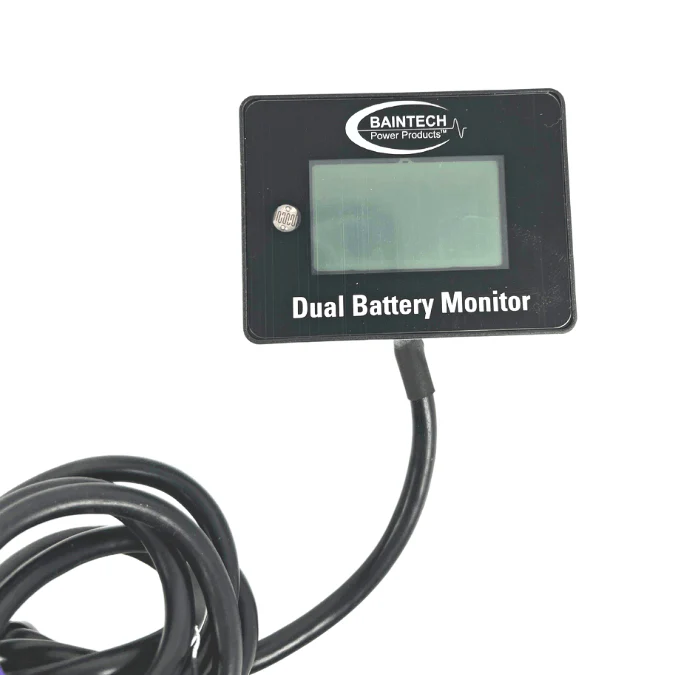
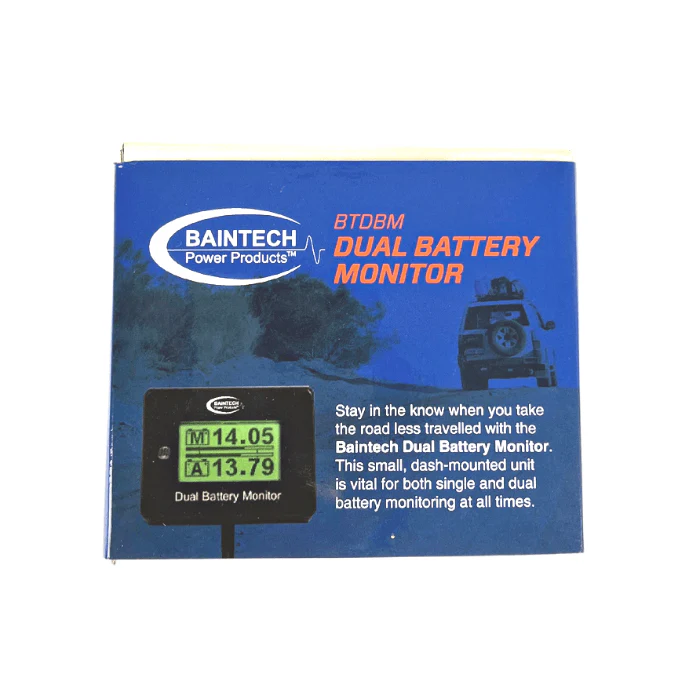
BAINTECH BTDBM Dual Battery Monitor
BAINTECH BTDBM Dual Battery Monitor - Digital Voltage Display and State of Charge Monitoring for Dual Battery Systems
Monitor dual battery systems effectively with the Baintech BTDBM Dual Battery Monitor—featuring simultaneous voltage monitoring of starter and auxiliary batteries providing real-time state of charge visibility, digital LED display showing precise voltage readings for both battery banks, color-coded LED indicators providing at-a-glance battery status assessment, compact flush-mount design integrating seamlessly into dash panels or console surfaces, simple two-wire installation per battery eliminating complex wiring requirements, wide voltage range compatibility (9-30V DC) suitable for 12V and 24V systems, low power consumption preserving battery charge during monitoring, and essential battery management tool for caravans, 4WD vehicles, boats, motorhomes, and mobile installations requiring reliable dual battery system monitoring preventing unexpected battery depletion and ensuring adequate starting power.
Product Overview
The Baintech BTDBM addresses dual battery system monitoring requirements providing real-time voltage display and state of charge indication for both starter battery and auxiliary battery—essential information for managing mobile electrical systems preventing auxiliary battery over-discharge while maintaining adequate starter battery charge ensuring reliable engine starting. Dual battery systems common in caravans, 4WD touring vehicles, boats, and motorhomes separate starting functions from auxiliary loads (fridges, lighting, inverters, accessories)—battery monitor enables users to assess both battery states simultaneously making informed decisions about power consumption, charging requirements, and electrical system management. Digital LED display provides precise voltage readings for each battery eliminating guesswork about battery condition—voltage directly correlates to state of charge enabling users to determine remaining capacity and charging needs. Color-coded LED indicators supplement voltage display providing intuitive at-a-glance status assessment—typically green indicating good charge, yellow/amber indicating moderate charge, and red indicating low charge requiring immediate attention or charging. Flush-mount design enables clean professional installation integrated into dash panels, console surfaces, or custom mounting locations appearing factory-installed rather than aftermarket addition—compact footprint consumes minimal dashboard real estate while providing comprehensive battery monitoring functionality. Simple installation requires only positive and negative wire connections to each battery—no complex programming, configuration, or additional sensors simplifying DIY installation for users with basic automotive electrical knowledge. Wide voltage range compatibility (9-30V DC typical) ensures operation across various battery states from deeply discharged to fully charged and accommodates both 12V and 24V electrical systems—single monitor suitable for diverse vehicle applications. Low power consumption (milliamps typical) ensures monitor operation negligibly impacts battery charge—continuous monitoring possible without concern for parasitic drain depleting batteries during storage or extended non-use periods.
Key Features
Simultaneous Dual Battery Monitoring: Independent monitoring of starter battery and auxiliary battery voltages providing comprehensive dual battery system visibility from single display unit. Eliminates need for multiple separate voltmeters or manual battery testing—both battery states visible at glance enabling informed power management decisions. Real-time voltage monitoring updates continuously tracking battery state changes during charging, discharging, and load variations. Essential for dual battery system management ensuring adequate starter battery charge for reliable engine starting while maximizing auxiliary battery utilization for appliances and accessories without over-discharge risking battery damage.
Digital LED Voltage Display: Precision digital display shows exact battery voltages (typically 0.1V resolution) for both starter and auxiliary batteries—accurate voltage readings enable precise state of charge determination and battery condition assessment. Superior to analog gauges or simple indicator lights providing specific voltage information rather than vague approximations. Digital display easily readable in various lighting conditions including bright sunlight and darkness—LED illumination ensures visibility day and night. Voltage readings directly correlate to battery state of charge—users familiar with battery voltage-SOC relationships can determine remaining capacity and charging requirements from voltage readings without separate SOC meters.
Color-Coded LED Status Indicators: Intuitive color-coded LED indicators provide at-a-glance battery status assessment supplementing voltage display—typically green LED indicates good charge (above 12.5V for 12V batteries), yellow/amber LED indicates moderate charge (12.0-12.5V range requiring monitoring), and red LED indicates low charge (below 12.0V requiring immediate charging or load reduction). Color-coding enables quick status assessment without reading voltage values—particularly valuable when driving or performing tasks where detailed display reading inconvenient. Visual alerts draw attention to low battery conditions preventing unexpected battery depletion and equipment shutdown.
Compact Flush-Mount Design: Low-profile flush mounting configuration creates clean professional installation integrated seamlessly into dash panels, console surfaces, or custom mounting locations. Compact footprint (typically 50-70mm diameter) consumes minimal dashboard real estate—suitable for installations where mounting space limited or aesthetics important. Flush design sits level with mounting surface preventing protruding housing disrupting aesthetics or creating obstacles. Black finish integrates with dark interior trim and console surfaces maintaining professional appearance. Installation requires single mounting hole (typically 52mm diameter standard gauge cutout) with rear access for wiring connections—standard gauge hole size enables replacement of existing unused gauge positions or standardized installation across vehicle types.
Simple Two-Wire Installation Per Battery: Straightforward installation requires only positive and negative wire connections to each battery—positive wire to battery positive terminal, negative wire to battery negative terminal or chassis ground. No complex programming, configuration menus, or sensor installation simplifying DIY installation for users with basic automotive electrical skills. Self-calibrating operation requires no setup procedures—connect wiring and monitor immediately operational displaying accurate voltage readings. Includes wiring for both batteries (typically 22-18 AWG wire adequate for low-current monitoring)—wire length sufficient for typical installations though custom wire runs possible for non-standard mounting locations. Clear wiring diagram and installation instructions included ensuring correct installation without confusion about polarity or connection points.
Wide Voltage Range Compatibility: Operates across wide voltage range (typically 9-30V DC) accommodating various battery states from deeply discharged to fully charged and compatible with both 12V and 24V electrical systems. Single monitor suitable for diverse vehicle applications eliminating need for voltage-specific models. Wide range ensures monitor remains operational throughout battery discharge preventing monitor shutdown when battery monitoring most critical. Overvoltage protection prevents monitor damage from charging system voltage spikes or transients—withstands typical alternator voltage regulation variations and battery charging voltages without damage.
Low Power Consumption: Minimal current draw (typically under 50mA—often 10-30mA) ensures continuous battery monitoring negligibly impacts battery charge—parasitic drain insignificant compared to battery self-discharge rates. Continuous monitoring possible during vehicle storage or extended non-use periods without concern for monitor draining batteries. No on/off switch required—monitor operates continuously providing battery status information whenever needed without user intervention. Low power consumption particularly important for auxiliary battery monitoring where preserving charge for appliances and accessories priority.
Essential Battery Management Information: Provides critical information for dual battery system management including: starter battery voltage ensuring adequate charge for reliable engine starting, auxiliary battery voltage indicating available capacity for appliances and accessories, charging status visible during alternator operation or solar charging showing batteries receiving charge, discharge rate observable during equipment operation showing load impact on batteries, and low battery warnings indicating need for charging or load reduction. Information enables proactive battery management preventing unexpected battery depletion, equipment shutdowns, or inability to start engine from depleted starter battery.
Versatile Installation Applications: Suitable for caravans monitoring house battery and starter battery during travel and camping, 4WD vehicles managing auxiliary battery for fridge, lighting, and accessories while preserving starter battery charge, boats monitoring starting battery and house battery for electronics, navigation equipment, and onboard systems, motorhomes managing multiple battery banks for appliances and systems, commercial vehicles with auxiliary equipment requiring battery monitoring, mobile workshops with dual battery setups powering tools and equipment, and any dual battery application requiring real-time voltage monitoring and state of charge visibility for effective battery management.
Quality Australian-Market Product: Designed and distributed for Australian market by Bainbridge Technologies (Baintech) addressing specific requirements of Australian mobile installations including harsh environmental conditions, diverse vehicle applications, and dual battery systems common in Australian caravanning and 4WD touring culture. Available through established Australian distribution networks including auto electrical retailers, caravan accessory suppliers, marine equipment distributors, and 4WD specialty stores with knowledgeable staff providing installation guidance and technical support.
Technical Specifications
| Part Number | BTDBM |
| SKU | BTDBM |
| Product Type | Dual Battery Monitor |
| Brand | Baintech |
| Display Type | Digital LED Voltage Display |
| Monitored Batteries | 2 (Starter + Auxiliary) |
| Voltage Range | 9-30V DC (12V/24V Compatible) |
| Voltage Resolution | 0.1V (typical) |
| Status Indicators | Color-Coded LED (Green/Yellow/Red typical) |
| Mounting Style | Flush Mount |
| Mounting Hole Size | 52mm (standard gauge cutout typical) |
| Housing Material | UV-Resistant Plastic |
| Housing Colour | Black |
| Power Consumption | <50mA (typical) |
| Operating Temperature | -20°C to +70°C (typical) |
| Installation | Two-Wire Per Battery (Positive + Negative) |
| Applications | Caravans, 4WD, Boats, Motorhomes, Dual Battery Systems |
Frequently Asked Questions
Q: How do I interpret voltage readings to determine battery state of charge?
A: Battery voltage correlates to state of charge (SOC)—for 12V lead-acid batteries: 12.7V+ indicates 100% charge (fully charged), 12.5V indicates approximately 75% charge (good condition), 12.2V indicates approximately 50% charge (moderate—recharge soon), 12.0V indicates approximately 25% charge (low—recharge immediately), below 11.8V indicates under 10% charge (critically low—risk of damage from over-discharge). For AGM and lithium batteries, voltage-SOC relationships differ slightly—AGM similar to lead-acid, lithium maintains higher voltage until deeply discharged then drops rapidly. Monitor both batteries: starter battery should remain above 12.5V ensuring reliable starting, auxiliary battery can be discharged further (to 12.0V for lead-acid, 50% DOD safe limit) but avoid regular deep discharge extending battery lifespan. Voltage readings most accurate when batteries at rest (no charging or discharging for 30+ minutes)—voltage under load appears lower than actual SOC, voltage during charging appears higher.
Q: Why do voltage readings fluctuate—is monitor faulty or batteries failing?
A: Voltage fluctuations normal and expected in dual battery systems—not indication of monitor fault or battery failure. Common causes of voltage changes: alternator charging increases voltage (14.2-14.8V typical during charging), load application decreases voltage (fridge compressor starting, lights operating, inverter running), battery rest voltage stabilizes after charging or discharging ceases (voltage rebounds after load removed or charging stopped), temperature affects battery voltage (cold batteries show lower voltage, warm batteries higher), and battery state of charge naturally varies during use. Rapid fluctuations during driving normal—alternator charges batteries increasing voltage, then load applications decrease voltage creating continuous variations. Stable voltage when parked with no loads and no charging indicates battery rest voltage—most accurate SOC indication. Gradual voltage decline over hours/days indicates battery self-discharge or parasitic loads draining charge—normal self-discharge approximately 3-5% monthly for lead-acid, faster for older batteries.
Q: Can I install dual battery monitor myself or need professional installation?
A: DIY installation straightforward for users with basic automotive electrical skills and tools. Installation process: identify suitable mounting location on dash or console with rear access for wiring, drill mounting hole matching monitor diameter (typically 52mm standard gauge cutout), route positive wire from monitor to each battery positive terminal (or nearby positive connection point), route negative wire from monitor to each battery negative terminal or chassis ground near battery, secure connections using ring terminals and appropriate fasteners, verify correct polarity (reverse polarity may damage monitor), insert monitor into mounting hole securing with retaining hardware, test monitor operation verifying voltage readings reasonable for both batteries. Professional installation recommended if: unfamiliar with automotive electrical systems, uncertain about wire routing through dash/firewall, concerned about correct connection points, or prefer professional workmanship and warranty. Installation typically requires: drill and hole saw for mounting hole, crimp tool for terminal installation, basic hand tools for terminal connections, and multimeter for verification (optional but recommended confirming correct voltage readings).
Q: What's difference between dual battery monitor and battery isolator—do I need both?
A: Dual battery monitor and battery isolator serve different functions—most dual battery systems benefit from both. Battery monitor (BTDBM) provides information—displays voltage and state of charge for both batteries enabling informed power management decisions but does not control charging or isolation. Battery isolator controls charging—manages which batteries receive alternator charge and prevents auxiliary battery from draining starter battery but provides no information about battery states. Typical dual battery system includes: battery isolator (VSR, DC-DC charger, or manual switch) managing charging and isolation between batteries, and battery monitor providing visibility into battery voltages and states. Monitor essential for: knowing when batteries require charging, assessing available auxiliary battery capacity for appliances, verifying starter battery maintaining adequate charge, and detecting electrical system problems from abnormal voltage readings. Isolator essential for: directing alternator charge to appropriate batteries, preventing auxiliary loads draining starter battery, and protecting starter battery ensuring reliable engine starting. For complete dual battery system: install isolator for control plus monitor for visibility—combined provide comprehensive battery management.
Q: Monitor shows one battery low voltage—what should I check and how to resolve?
A: Systematic troubleshooting sequence: verify voltage reading accuracy by testing battery with multimeter (confirms monitor reading correct or identifies monitor calibration issue), check battery connections for corrosion, looseness, or high resistance (clean and tighten terminals if issues found), inspect battery isolator operation ensuring batteries charging properly (VSR connecting during charging, DC-DC charger operating, manual switch in correct position), test alternator output voltage ensuring adequate charging voltage (should see 14.2-14.8V at batteries during engine operation), assess battery condition and age (old or damaged batteries may not hold charge—load test reveals battery health), evaluate loads on low-voltage battery determining if excessive consumption causing discharge (auxiliary battery powering fridge, inverter, lights—reduce loads if necessary), verify battery capacity adequate for application (undersized battery depletes quickly—consider capacity upgrade), check for parasitic drains when vehicle off (faulty equipment or wiring drawing current), and examine battery charging system including alternator, wiring, and isolator for faults preventing proper charging. Resolution depends on cause: clean connections restoring electrical contact, charge battery fully using mains charger or extended driving, replace old/damaged battery failing to hold charge, upgrade battery capacity if consistently depleted during normal use, or repair charging system faults preventing proper battery charging.
Original: $122.18
-65%$122.18
$42.76Product Information
Product Information
Shipping & Returns
Shipping & Returns
Description
BAINTECH BTDBM Dual Battery Monitor - Digital Voltage Display and State of Charge Monitoring for Dual Battery Systems
Monitor dual battery systems effectively with the Baintech BTDBM Dual Battery Monitor—featuring simultaneous voltage monitoring of starter and auxiliary batteries providing real-time state of charge visibility, digital LED display showing precise voltage readings for both battery banks, color-coded LED indicators providing at-a-glance battery status assessment, compact flush-mount design integrating seamlessly into dash panels or console surfaces, simple two-wire installation per battery eliminating complex wiring requirements, wide voltage range compatibility (9-30V DC) suitable for 12V and 24V systems, low power consumption preserving battery charge during monitoring, and essential battery management tool for caravans, 4WD vehicles, boats, motorhomes, and mobile installations requiring reliable dual battery system monitoring preventing unexpected battery depletion and ensuring adequate starting power.
Product Overview
The Baintech BTDBM addresses dual battery system monitoring requirements providing real-time voltage display and state of charge indication for both starter battery and auxiliary battery—essential information for managing mobile electrical systems preventing auxiliary battery over-discharge while maintaining adequate starter battery charge ensuring reliable engine starting. Dual battery systems common in caravans, 4WD touring vehicles, boats, and motorhomes separate starting functions from auxiliary loads (fridges, lighting, inverters, accessories)—battery monitor enables users to assess both battery states simultaneously making informed decisions about power consumption, charging requirements, and electrical system management. Digital LED display provides precise voltage readings for each battery eliminating guesswork about battery condition—voltage directly correlates to state of charge enabling users to determine remaining capacity and charging needs. Color-coded LED indicators supplement voltage display providing intuitive at-a-glance status assessment—typically green indicating good charge, yellow/amber indicating moderate charge, and red indicating low charge requiring immediate attention or charging. Flush-mount design enables clean professional installation integrated into dash panels, console surfaces, or custom mounting locations appearing factory-installed rather than aftermarket addition—compact footprint consumes minimal dashboard real estate while providing comprehensive battery monitoring functionality. Simple installation requires only positive and negative wire connections to each battery—no complex programming, configuration, or additional sensors simplifying DIY installation for users with basic automotive electrical knowledge. Wide voltage range compatibility (9-30V DC typical) ensures operation across various battery states from deeply discharged to fully charged and accommodates both 12V and 24V electrical systems—single monitor suitable for diverse vehicle applications. Low power consumption (milliamps typical) ensures monitor operation negligibly impacts battery charge—continuous monitoring possible without concern for parasitic drain depleting batteries during storage or extended non-use periods.
Key Features
Simultaneous Dual Battery Monitoring: Independent monitoring of starter battery and auxiliary battery voltages providing comprehensive dual battery system visibility from single display unit. Eliminates need for multiple separate voltmeters or manual battery testing—both battery states visible at glance enabling informed power management decisions. Real-time voltage monitoring updates continuously tracking battery state changes during charging, discharging, and load variations. Essential for dual battery system management ensuring adequate starter battery charge for reliable engine starting while maximizing auxiliary battery utilization for appliances and accessories without over-discharge risking battery damage.
Digital LED Voltage Display: Precision digital display shows exact battery voltages (typically 0.1V resolution) for both starter and auxiliary batteries—accurate voltage readings enable precise state of charge determination and battery condition assessment. Superior to analog gauges or simple indicator lights providing specific voltage information rather than vague approximations. Digital display easily readable in various lighting conditions including bright sunlight and darkness—LED illumination ensures visibility day and night. Voltage readings directly correlate to battery state of charge—users familiar with battery voltage-SOC relationships can determine remaining capacity and charging requirements from voltage readings without separate SOC meters.
Color-Coded LED Status Indicators: Intuitive color-coded LED indicators provide at-a-glance battery status assessment supplementing voltage display—typically green LED indicates good charge (above 12.5V for 12V batteries), yellow/amber LED indicates moderate charge (12.0-12.5V range requiring monitoring), and red LED indicates low charge (below 12.0V requiring immediate charging or load reduction). Color-coding enables quick status assessment without reading voltage values—particularly valuable when driving or performing tasks where detailed display reading inconvenient. Visual alerts draw attention to low battery conditions preventing unexpected battery depletion and equipment shutdown.
Compact Flush-Mount Design: Low-profile flush mounting configuration creates clean professional installation integrated seamlessly into dash panels, console surfaces, or custom mounting locations. Compact footprint (typically 50-70mm diameter) consumes minimal dashboard real estate—suitable for installations where mounting space limited or aesthetics important. Flush design sits level with mounting surface preventing protruding housing disrupting aesthetics or creating obstacles. Black finish integrates with dark interior trim and console surfaces maintaining professional appearance. Installation requires single mounting hole (typically 52mm diameter standard gauge cutout) with rear access for wiring connections—standard gauge hole size enables replacement of existing unused gauge positions or standardized installation across vehicle types.
Simple Two-Wire Installation Per Battery: Straightforward installation requires only positive and negative wire connections to each battery—positive wire to battery positive terminal, negative wire to battery negative terminal or chassis ground. No complex programming, configuration menus, or sensor installation simplifying DIY installation for users with basic automotive electrical skills. Self-calibrating operation requires no setup procedures—connect wiring and monitor immediately operational displaying accurate voltage readings. Includes wiring for both batteries (typically 22-18 AWG wire adequate for low-current monitoring)—wire length sufficient for typical installations though custom wire runs possible for non-standard mounting locations. Clear wiring diagram and installation instructions included ensuring correct installation without confusion about polarity or connection points.
Wide Voltage Range Compatibility: Operates across wide voltage range (typically 9-30V DC) accommodating various battery states from deeply discharged to fully charged and compatible with both 12V and 24V electrical systems. Single monitor suitable for diverse vehicle applications eliminating need for voltage-specific models. Wide range ensures monitor remains operational throughout battery discharge preventing monitor shutdown when battery monitoring most critical. Overvoltage protection prevents monitor damage from charging system voltage spikes or transients—withstands typical alternator voltage regulation variations and battery charging voltages without damage.
Low Power Consumption: Minimal current draw (typically under 50mA—often 10-30mA) ensures continuous battery monitoring negligibly impacts battery charge—parasitic drain insignificant compared to battery self-discharge rates. Continuous monitoring possible during vehicle storage or extended non-use periods without concern for monitor draining batteries. No on/off switch required—monitor operates continuously providing battery status information whenever needed without user intervention. Low power consumption particularly important for auxiliary battery monitoring where preserving charge for appliances and accessories priority.
Essential Battery Management Information: Provides critical information for dual battery system management including: starter battery voltage ensuring adequate charge for reliable engine starting, auxiliary battery voltage indicating available capacity for appliances and accessories, charging status visible during alternator operation or solar charging showing batteries receiving charge, discharge rate observable during equipment operation showing load impact on batteries, and low battery warnings indicating need for charging or load reduction. Information enables proactive battery management preventing unexpected battery depletion, equipment shutdowns, or inability to start engine from depleted starter battery.
Versatile Installation Applications: Suitable for caravans monitoring house battery and starter battery during travel and camping, 4WD vehicles managing auxiliary battery for fridge, lighting, and accessories while preserving starter battery charge, boats monitoring starting battery and house battery for electronics, navigation equipment, and onboard systems, motorhomes managing multiple battery banks for appliances and systems, commercial vehicles with auxiliary equipment requiring battery monitoring, mobile workshops with dual battery setups powering tools and equipment, and any dual battery application requiring real-time voltage monitoring and state of charge visibility for effective battery management.
Quality Australian-Market Product: Designed and distributed for Australian market by Bainbridge Technologies (Baintech) addressing specific requirements of Australian mobile installations including harsh environmental conditions, diverse vehicle applications, and dual battery systems common in Australian caravanning and 4WD touring culture. Available through established Australian distribution networks including auto electrical retailers, caravan accessory suppliers, marine equipment distributors, and 4WD specialty stores with knowledgeable staff providing installation guidance and technical support.
Technical Specifications
| Part Number | BTDBM |
| SKU | BTDBM |
| Product Type | Dual Battery Monitor |
| Brand | Baintech |
| Display Type | Digital LED Voltage Display |
| Monitored Batteries | 2 (Starter + Auxiliary) |
| Voltage Range | 9-30V DC (12V/24V Compatible) |
| Voltage Resolution | 0.1V (typical) |
| Status Indicators | Color-Coded LED (Green/Yellow/Red typical) |
| Mounting Style | Flush Mount |
| Mounting Hole Size | 52mm (standard gauge cutout typical) |
| Housing Material | UV-Resistant Plastic |
| Housing Colour | Black |
| Power Consumption | <50mA (typical) |
| Operating Temperature | -20°C to +70°C (typical) |
| Installation | Two-Wire Per Battery (Positive + Negative) |
| Applications | Caravans, 4WD, Boats, Motorhomes, Dual Battery Systems |
Frequently Asked Questions
Q: How do I interpret voltage readings to determine battery state of charge?
A: Battery voltage correlates to state of charge (SOC)—for 12V lead-acid batteries: 12.7V+ indicates 100% charge (fully charged), 12.5V indicates approximately 75% charge (good condition), 12.2V indicates approximately 50% charge (moderate—recharge soon), 12.0V indicates approximately 25% charge (low—recharge immediately), below 11.8V indicates under 10% charge (critically low—risk of damage from over-discharge). For AGM and lithium batteries, voltage-SOC relationships differ slightly—AGM similar to lead-acid, lithium maintains higher voltage until deeply discharged then drops rapidly. Monitor both batteries: starter battery should remain above 12.5V ensuring reliable starting, auxiliary battery can be discharged further (to 12.0V for lead-acid, 50% DOD safe limit) but avoid regular deep discharge extending battery lifespan. Voltage readings most accurate when batteries at rest (no charging or discharging for 30+ minutes)—voltage under load appears lower than actual SOC, voltage during charging appears higher.
Q: Why do voltage readings fluctuate—is monitor faulty or batteries failing?
A: Voltage fluctuations normal and expected in dual battery systems—not indication of monitor fault or battery failure. Common causes of voltage changes: alternator charging increases voltage (14.2-14.8V typical during charging), load application decreases voltage (fridge compressor starting, lights operating, inverter running), battery rest voltage stabilizes after charging or discharging ceases (voltage rebounds after load removed or charging stopped), temperature affects battery voltage (cold batteries show lower voltage, warm batteries higher), and battery state of charge naturally varies during use. Rapid fluctuations during driving normal—alternator charges batteries increasing voltage, then load applications decrease voltage creating continuous variations. Stable voltage when parked with no loads and no charging indicates battery rest voltage—most accurate SOC indication. Gradual voltage decline over hours/days indicates battery self-discharge or parasitic loads draining charge—normal self-discharge approximately 3-5% monthly for lead-acid, faster for older batteries.
Q: Can I install dual battery monitor myself or need professional installation?
A: DIY installation straightforward for users with basic automotive electrical skills and tools. Installation process: identify suitable mounting location on dash or console with rear access for wiring, drill mounting hole matching monitor diameter (typically 52mm standard gauge cutout), route positive wire from monitor to each battery positive terminal (or nearby positive connection point), route negative wire from monitor to each battery negative terminal or chassis ground near battery, secure connections using ring terminals and appropriate fasteners, verify correct polarity (reverse polarity may damage monitor), insert monitor into mounting hole securing with retaining hardware, test monitor operation verifying voltage readings reasonable for both batteries. Professional installation recommended if: unfamiliar with automotive electrical systems, uncertain about wire routing through dash/firewall, concerned about correct connection points, or prefer professional workmanship and warranty. Installation typically requires: drill and hole saw for mounting hole, crimp tool for terminal installation, basic hand tools for terminal connections, and multimeter for verification (optional but recommended confirming correct voltage readings).
Q: What's difference between dual battery monitor and battery isolator—do I need both?
A: Dual battery monitor and battery isolator serve different functions—most dual battery systems benefit from both. Battery monitor (BTDBM) provides information—displays voltage and state of charge for both batteries enabling informed power management decisions but does not control charging or isolation. Battery isolator controls charging—manages which batteries receive alternator charge and prevents auxiliary battery from draining starter battery but provides no information about battery states. Typical dual battery system includes: battery isolator (VSR, DC-DC charger, or manual switch) managing charging and isolation between batteries, and battery monitor providing visibility into battery voltages and states. Monitor essential for: knowing when batteries require charging, assessing available auxiliary battery capacity for appliances, verifying starter battery maintaining adequate charge, and detecting electrical system problems from abnormal voltage readings. Isolator essential for: directing alternator charge to appropriate batteries, preventing auxiliary loads draining starter battery, and protecting starter battery ensuring reliable engine starting. For complete dual battery system: install isolator for control plus monitor for visibility—combined provide comprehensive battery management.
Q: Monitor shows one battery low voltage—what should I check and how to resolve?
A: Systematic troubleshooting sequence: verify voltage reading accuracy by testing battery with multimeter (confirms monitor reading correct or identifies monitor calibration issue), check battery connections for corrosion, looseness, or high resistance (clean and tighten terminals if issues found), inspect battery isolator operation ensuring batteries charging properly (VSR connecting during charging, DC-DC charger operating, manual switch in correct position), test alternator output voltage ensuring adequate charging voltage (should see 14.2-14.8V at batteries during engine operation), assess battery condition and age (old or damaged batteries may not hold charge—load test reveals battery health), evaluate loads on low-voltage battery determining if excessive consumption causing discharge (auxiliary battery powering fridge, inverter, lights—reduce loads if necessary), verify battery capacity adequate for application (undersized battery depletes quickly—consider capacity upgrade), check for parasitic drains when vehicle off (faulty equipment or wiring drawing current), and examine battery charging system including alternator, wiring, and isolator for faults preventing proper charging. Resolution depends on cause: clean connections restoring electrical contact, charge battery fully using mains charger or extended driving, replace old/damaged battery failing to hold charge, upgrade battery capacity if consistently depleted during normal use, or repair charging system faults preventing proper battery charging.